What should you do in the first 10 minutes after a pipe bursts?
Shut off the main water valve before anything else. In most Augusta homes it sits in the basement near the front foundation wall, in a crawlspace, or in a utility closet on a slab build. Turn it clockwise until it stops. Then kill power to the affected area at the breaker panel if water is anywhere near outlets, light fixtures, or appliances. Once water and electricity are off, photograph everything before you move a single item. Wide shots, close-ups of the failed pipe, water lines on walls, soaked contents. Your insurance adjuster will ask for these, and memory is unreliable when adrenaline is running.
After documentation, start moving valuables up and out. Lift furniture legs onto foil or plastic to stop wood stain from bleeding into carpet. Pull up rugs. Open windows only if outdoor humidity is lower than indoor, otherwise you are making the drying problem worse. For a deeper walkthrough of triage, our team keeps a guide on first steps after water damage that mirrors what our techs do on arrival.
One more thing most homeowners miss in those first minutes: locate the failure point and contain it locally if you can. A towel pressed against a pinhole leak buys time. A bucket under a slow drip from a ceiling catches gallons before they soak the subfloor. If you can see the burst, wrap it with a rubber patch and hose clamps from any hardware store. These are temporary fixes, but they reduce the volume of water reaching finish materials while you wait on Augusta Water Restoration to roll a truck.
How fast does water actually spread through your home?
Faster than most homeowners expect. A half-inch supply line under a sink can release roughly 4 to 6 gallons per minute at typical Augusta municipal pressure. That is 240 to 360 gallons in an hour. Drywall wicks water vertically at about one inch per hour. Engineered hardwood begins cupping inside 12 hours. Insulation in exterior walls holds moisture for weeks if it is not pulled out. The mold clock starts at hour 24 to 48, which is why we wrote about the 24 to 48 hour mold window in detail. Waiting until morning to call almost always costs more than calling at midnight.
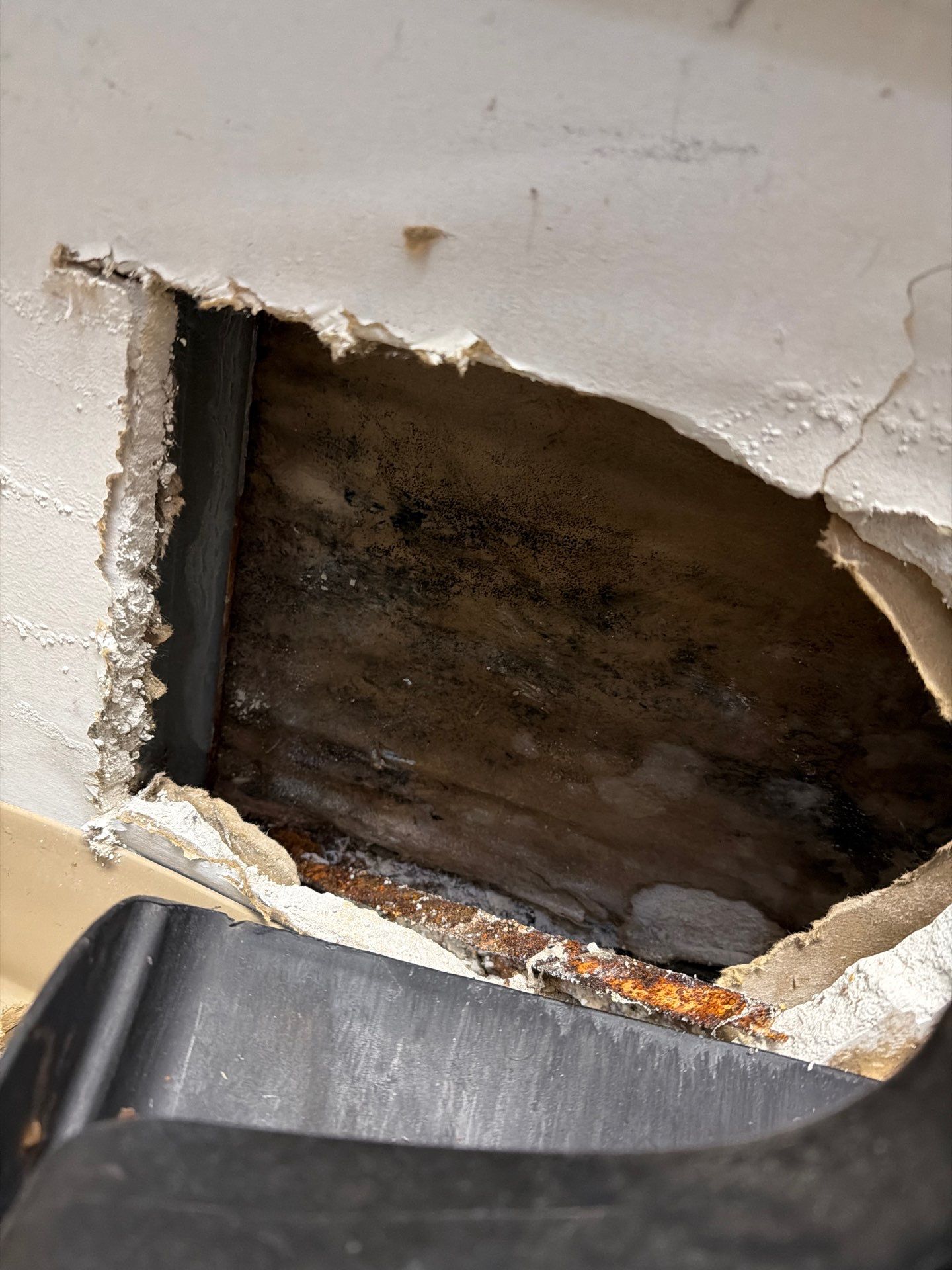
Gravity also plays a bigger role than people realize. Water from a second-floor burst will travel along joists, drop through can-light openings, and collect in light fixtures on the first-floor ceiling. We have seen single bathroom leaks damage three levels of a home because the water followed plumbing chases all the way to the basement slab. Assume the visible damage is roughly half of the real damage until moisture mapping proves otherwise.
What does professional restoration actually involve?
When our crew arrives at a Augusta address, the first 30 minutes are inspection and moisture mapping. We use penetrating and non-penetrating meters to find water you cannot see, especially behind cabinets, under flooring, and inside wall cavities. Extraction comes next, with truck-mounted units pulling standing water at 100-plus gallons per minute. Then we set the drying chamber: air movers every 10 to 16 linear feet of wet wall, commercial dehumidifiers sized to the cubic footage, and daily moisture readings logged for the insurance file. Most jobs dry in 3 to 5 days. Anything still reading above 16 percent moisture content after day 5 gets reassessed for hidden saturation or material removal.
How can you tell the drying is actually working?
Ask your technician for the daily log. A legitimate Augusta Water Restoration drying plan shows decreasing moisture content readings at the same probe locations every 24 hours. If the numbers stall for two consecutive days, something is trapping moisture, usually wet insulation behind drywall or saturated subfloor under tile. That triggers a controlled demolition step rather than more fan time. Endless drying without falling numbers is a sign the plan needs to change, not continue.
Why do pipes burst in the first place, and which ones fail most often in Augusta?
Three causes dominate. Freeze expansion is the headline cause from December through February, especially in pipes running through uninsulated exterior walls, attic spaces above bonus rooms, and crawlspaces. Corrosion takes out older copper and galvanized lines in homes built before 1990. Mechanical failure, meaning a bad solder joint, a cracked PEX fitting, or a failed washing machine hose, causes the rest. In Augusta specifically, we see a spike in supply-line and ice-maker line failures because braided stainless hoses have a service life of roughly 5 to 8 years and most homeowners never replace them.
Water hammer is the quiet fourth cause. Every time a dishwasher or washing machine snaps a solenoid valve shut, the pressure wave travels back through the supply lines. Over years, that shock fatigues fittings and thins copper at elbows. If you hear a bang in your walls when an appliance cycles, the system is telling you something. A hammer arrestor is a $20 part that can prevent a $10,000 loss.
When is a burst pipe more than just water damage?
If the pipe was a drain line rather than a supply line, you are looking at a Category 2 or Category 3 loss, which means greywater or blackwater contamination. The cleanup protocol changes completely, and so does the cost. Affected porous materials usually have to be removed rather than dried. If your situation involves any sewage backup, do not run fans across it. Read our note on why sewage backup is a Category 3 emergency and call before touching anything.
Does homeowners insurance cover a burst pipe?
In most cases, yes. A sudden and accidental discharge of water from a plumbing system is covered under standard HO-3 policies in Indiana. What insurance will not cover is gradual leakage you should have noticed, freeze damage if the home was unoccupied and unheated, or damage from a pipe that failed because of long-term corrosion the carrier deems neglect. File the claim the same day. Keep every receipt, every photo, and every text message with contractors. We help clients document properly through our walkthrough on filing a water damage insurance claim, and we bill directly to most major carriers so you are not floating the cost.
Pay attention to your deductible math before you file. If the total loss is close to your deductible, a claim may not be worth the premium impact at renewal. If the loss is clearly above it, file fast and let the adjuster scope the job alongside our estimator. Joint scoping at the property prevents the supplement battles that drag claims out for months.
What does burst pipe repair really cost in 2024?
The honest answer has two parts: the plumbing repair itself and the water damage restoration after. The pipe fix is usually the smaller number. Replacing a section of copper or PEX, including access cuts in drywall, runs $350 to $1,500 depending on location and whether the wall has to be opened in finished space. Repiping a section of a home runs $1,500 to $4,500.
The restoration side is where the budget moves. A contained kitchen leak with quick response often lands between $1,500 and $4,000. A burst supply line that ran for several hours into a finished basement typically runs $4,500 to $12,000 once you factor extraction, structural drying with air movers and dehumidifiers for 3 to 5 days, antimicrobial treatment, and replacement of saturated drywall, baseboard, and flooring. Whole-home Category 1 losses with hardwood damage can exceed $25,000. Our team breaks down pricing further in our overview of water damage restoration services, and the numbers track with national IICRC industry data.