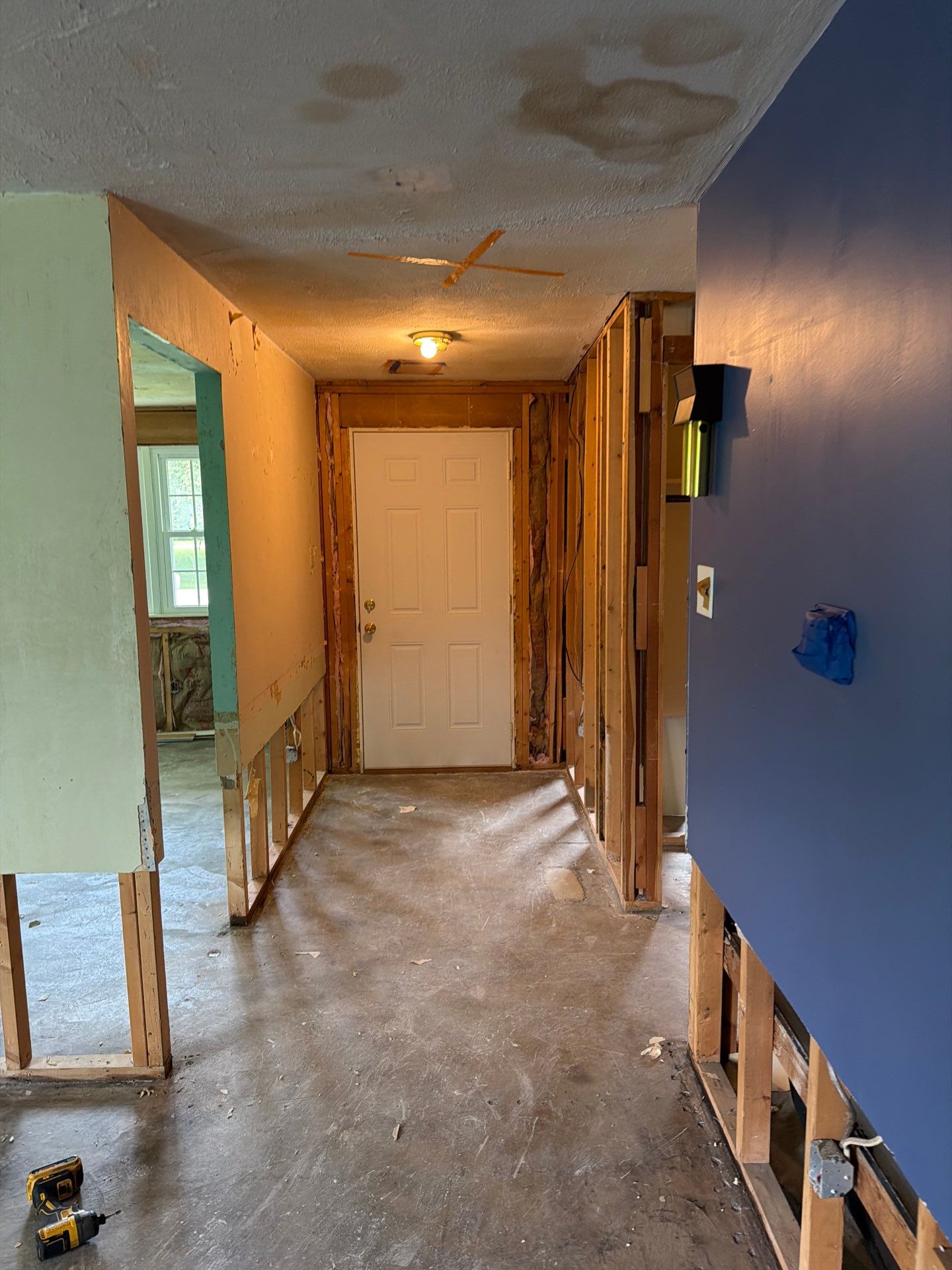
Why the Source of the Leak Drives Every Decision
When water shows up on a ceiling, gravity has already done most of the work of hiding the origin. Water travels along the top of drywall, follows joists, runs down wires, and exits at the lowest screw or seam. The wet spot you see may sit three, six, or twelve feet away from the actual failure. That matters because the IICRC categories (Cat 1 clean water, Cat 2 gray water, Cat 3 black water) and classes (Class 1 through 4, based on how much porous material is wet) determine what has to be removed, what can be dried in place, and how aggressively we have to set up containment.
A pinhole in a copper supply line above the kitchen is Cat 1. We can often save the drywall with strategic cuts, injection drying, and 3 to 5 days of dehumidification. A toilet supply that has been weeping behind a second-floor vanity for a month is a different story: the subfloor is likely compromised, the joist tops are stained, and microbial growth has had time to start. That is a tear-out job, not a dry-in-place job. Confusing those two scenarios is how homeowners end up paying twice, once for a cosmetic patch and again six months later when mold blooms through the new paint.
Before you call anyone, shut off the water if you can identify the line, place a bucket under any active drip, and (carefully) poke a small relief hole in a bulging ceiling so the water drains in one spot instead of collapsing a four-foot section onto your floor. Then read the table below and match your situation honestly. If the source is sewage or a roof failure during an active storm, skip ahead and call. Those do not wait.
It also helps to think about what is directly above the stain before a technician arrives. A ceiling under a bathroom tells a very different story than a ceiling under an attic or under an exterior wall that catches wind-driven rain. The room above narrows the list of possible sources from a dozen to two or three, and that focus saves diagnostic time. If you have access to the attic or the cavity above the ceiling, a flashlight pass (without stepping off the joists) often reveals the wet path, a rusted strap, a sweating duct, or a nail head dripping at the underside of the roof deck.
Ceiling Leak Sources Compared: Cost, Timeline, and What Actually Has to Come Out
The table below reflects what we see on real Augusta jobs, not catalog pricing. Ranges assume a single-room ceiling area of roughly 100 to 200 square feet of affected drywall. Larger areas scale up. All ranges include water extraction, drying equipment, antimicrobial treatment, and drywall replacement, but not finish painting of the entire room or upstream plumbing repair by a licensed plumber.
| Leak Source | IICRC Category | Typical Signs | Drying Time | Tear-Out Likely? | Restoration Cost Range | Insurance Outlook |
|---|---|---|---|---|---|---|
| Supply line pinhole (copper or PEX) | Cat 1 | Clean drip, fresh stain, no odor | 3 to 5 days | Sometimes, small access cuts | $1,200 to $3,500 | Usually covered, sudden and accidental |
| Toilet supply or wax ring failure | Cat 2 to Cat 3 | Yellow ring, musty smell, soft subfloor above | 5 to 7 days | Yes, drywall and often subfloor | $2,800 to $7,500 | Covered if sudden, denied if long-term seepage |
| Tub or shower pan leak | Cat 2 | Stain appears only after showering | 4 to 7 days | Yes, ceiling and access for repair | $2,200 to $6,000 | Mixed, often denied as maintenance |
| Roof leak (shingle, flashing, valley) | Cat 1 escalating to Cat 2 | Stain after rain, attic insulation matted | 4 to 6 days | Yes, insulation and drywall | $2,500 to $8,000 | Covered if storm-related, see storm damage |
| HVAC condensate overflow | Cat 2 | Stain near return or air handler, summer only | 3 to 5 days | Sometimes | $1,500 to $4,200 | Often denied, treated as maintenance |
| Ice dam backup | Cat 1 | Stain at exterior wall after thaw | 4 to 7 days | Yes, often along the entire wall line | $3,000 to $9,500 | Usually covered under winter peril |
| Upstairs sewage backup through ceiling | Cat 3 | Odor, dark staining, debris | 7 to 10 days | Always, full demolition | $6,500 to $18,000+ | Covered if backup rider exists, see sewage backup cleanup |
Reading the Table: What These Numbers Actually Mean for Your Claim
The pattern in that table is not subtle. The further you slide from Cat 1 toward Cat 3, the more demolition is non-negotiable and the more your insurance adjuster will scrutinize the timeline. Carriers in Indiana routinely deny ceiling claims where the staining shows tree-ring patterns, because rings indicate repeated wetting and drying over weeks. That falls under maintenance, not a sudden event. A single, fresh, expanding stain with a clear source tells a different story and usually pays.
This is why documentation in the first 24 hours matters more than the repair itself. Photograph the stain, the source if visible, any standing water, and the moisture meter readings if you have a technician on site. Augusta Water Restoration writes IICRC-aligned scopes that match the language adjusters expect, which shortens the back-and-forth and gets your home dry faster. When the source is plumbing inside a wall, we coordinate the access cuts so your plumber can work quickly and we can resume drying the same day.
The cost ranges deserve a second look too. The low end of each band assumes we arrive within 24 hours of the loss, the source is shut off, and the framing behind the drywall is still dry. The high end assumes delayed discovery, saturated insulation, and at least one secondary material (hardwood, cabinetry, or a light fixture) that has to be addressed. Most Augusta ceiling jobs land in the middle third of the range, and the single biggest variable that pushes a job toward the high end is the homeowner waiting a weekend to call, hoping the stain will dry on its own. It rarely does, because the cavity above stays humid long after the visible surface looks normal.
One more thing worth saying plainly: if the ceiling is actively sagging, bulging, or showing daylight cracks around a wet area, stay out of the room. Saturated drywall holds far more weight than it looks like it should, until it does not. Call us, call a plumber, and let the structure come down in a controlled way.